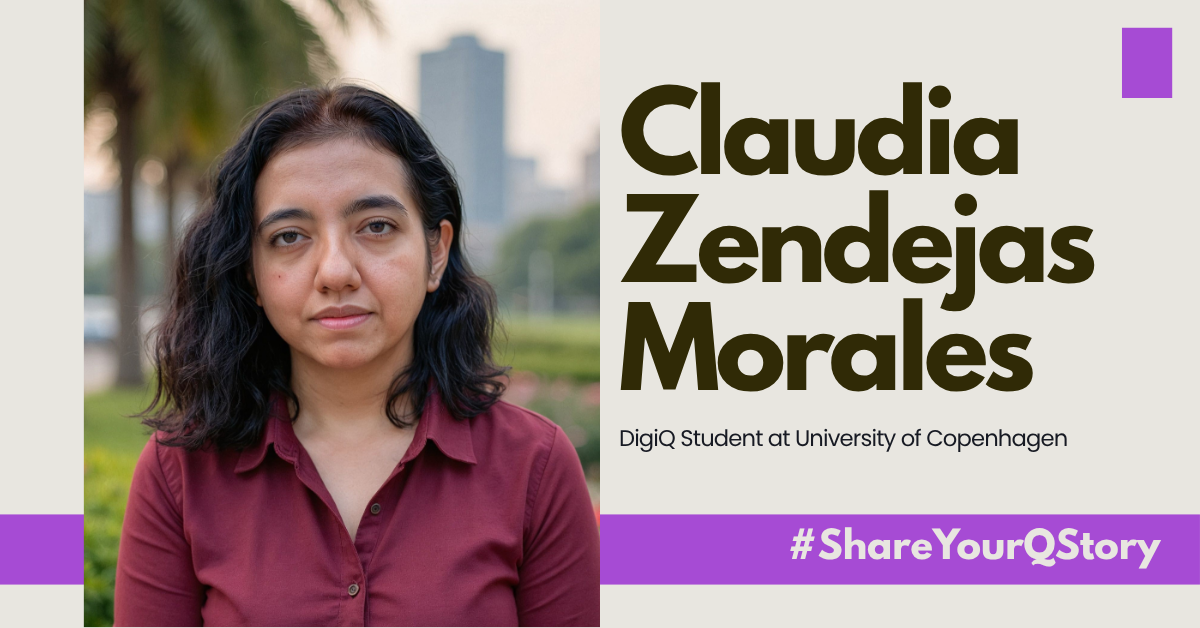
-
One of the areas that has excited me the most is the theoretical side of quantum information. I have always been fascinated by how quantum information theory allows us to ask very precise questions about what is possible, what is impossible, and what resources are needed to process information in a genuinely quantum way. In particular, I have really enjoyed studying quantum algorithms and quantum information from a theoretical perspective. I like that these topics sit at the intersection of physics, mathematics, and computer science: they require formal reasoning, but they are also connected to the long-term development of quantum technologies What I enjoy most is that quantum information feels both abstract and alive: abstract because it involves rigorous mathematical structures, and alive because those structures help us understand real questions about quantum systems, computation, and the limits of information processing. For me, this is exactly the kind of environment that makes research exciting
-
Something people often don't see is that scientific journeys can be nonlinear, even when they may look more straightforward from the outside. Science is often narrated through achievements, degrees, publications, or projects, but behind that there are many moments of exploration, uncertainty, gradual construction, and invisible work: studying on your own, filling gaps, asking questions, finding community, and continuing to learn even when the next step is not completely clear. I do not think these changes of direction are necessarily a problem; sometimes they are part of the process. Moving across areas, learning new tools and methods, and connecting different ways of thinking can become a strength. Studying computer engineering before physics shaped the way I approach quantum information and quantum algorithms, giving me a computational perspective that now feels very natural in my research interests. For me, this is a reminder that there is not only one way to build a scientific path, and that diverse trajectories can bring valuable perspectives to research.
-
One misconception people often have about quantum computing is that it is a kind of "magic computer" that will automatically be faster than classical computers and solve every difficult problem. This has created a lot of misinformation and hype around the field. I would explain it differently by saying that quantum computers are not universally better computers; they are computers based on different physical principles. Because they use quantum phenomena such as superposition, interference, and entanglement, they allow us to process information in ways that are not available to classical computers. But this does not mean they are useful for every problem, or that today's devices can already do everything people imagine. I think a more honest explanation is that quantum computing is powerful because it expands the way we think about computation. Its potential lies in specific problems, carefully designed algorithms, and a deep understanding of both its possibilities and its limitations. Communicating that balance is important: we can be excited about the field without turning it into hype
-
I would tell them: do not wait until the path looks perfect to begin. Quantum science can seem intimidating from the outside, because it brings together physics, mathematics, computer science, and many abstract ideas. But nobody enters the field knowing everything. You start with curiosity, and then you build the tools step by step Try things: take a course, attend a seminar, read notes, work on a small project, ask questions, and look for a community. Learning with others makes a huge difference: you receive support, but you also realize that confusion, patience, and persistence are part of the process. I would also remind them that there is not only one correct way to enter quantum science. Different backgrounds can become strengths. What matters is to keep your curiosity alive, take the next step even if it is small, and remember that science is built through time, collaboration, and care.
-
During difficult moments, something that has helped me is returning to curiosity. When motivation is low or the path feels unclear, I try to make the question smaller: not "how do I solve everything?", but "what is one thing I can still try to understand?" Sometimes that small step is reading a few pages, writing down a question, asking someone for help, or coming back to a problem after some distance. Over time, I have learned that progress in science is not always visible while it is happening. Sometimes it looks like confusion, repetition, or very slow movement. But curiosity helps me stay connected to the reason I started: the desire to understand a little more. Community also helps, because sharing doubts and ideas makes the process less isolated. For me, continuing often means holding on to curiosity and taking the next small step, even when the path feels uncertain.